The history of Kahuna bodywork.
The history of Kahuna bodywork.
Kahuna bodywork descends from Hawaiian healing traditions practised by kahuna lapa'au (healing experts) for many centuries. After 19th-century suppression of indigenous practices and 20th-century revival, teachers like Kahu Abraham Kawai'i and Mette Sorensen carried the tradition into modern international training.
The history of Kahuna massage isn't a clean linear story. It runs through centuries of pre-contact Hawaiian practice, decades of colonial suppression, and a 20th-century revival that brought the work to international students through a small number of named teachers. Understanding this history matters for anyone receiving or studying the modality: the form taught today carries genuine Hawaiian roots, but is a modern adaptation rather than an unbroken traditional transmission. I'm Lorena, a Sunshine Coast remedial and Kahuna therapist trained through Mette's Institute (Levels 1 to 3); this piece walks through the four historical periods that shaped what Kahuna bodywork is now.
Four historical periods.
The origins of Kahuna massage span roughly four distinguishable periods, each with its own conditions and consequences for the modality.
Pre-contact Hawaiian practice
Massage and bodywork were embedded in everyday Hawaiian life, practised across families and communities. More refined forms were carried by kahuna lapa'au, healing specialists trained through teacher-to-student transmission within the broader framework of kahuna as experts in many fields. The term lomi lomi meant simply "to rub, knead, or massage". The work was integrated with spiritual practice, breath, prayer, and the wider Hawaiian healing system rather than treated as a separate clinical service.
Suppression and survival
The arrival of Christian missionaries in 1820 began a long period of suppression of indigenous Hawaiian practices. The kapu (sacred law) system was broken in 1819 and replaced with imposed legal and religious frameworks; hula was banned, traditional healing was discouraged or outlawed at various points, and kahuna practitioners often had to work covertly. Family-line transmission continued within Hawaiian communities, but the public practice and broader cultural integration were significantly damaged across more than a century.
The cultural revival
The mid-20th century brought the Hawaiian Renaissance, a broad cultural revival movement. Native Hawaiian practitioners began to share traditional knowledge more openly with non-Hawaiian students. Aunty Margaret Machado (1916 to 2009) became one of the most-recognised teachers of traditional Lomi Lomi to outside students from the 1970s onward. Around the same period, Kahu Abraham Kawai'i (1936 to 2004) began teaching Hawaiian Temple Bodywork internationally; this lineage became the foundation for much of the Kahuna bodywork now taught in Australia and Europe.
International transmission
From the 1990s, the Western lineages developed into formal training curricula. In Australia and Europe, Mette Sorensen (a student in the Kawai'i lineage) founded Mette's Institute and developed a structured curriculum across Levels 1, 2, and 3 that is now the standard training for many Australian Kahuna practitioners. Other teachers maintain alternative lineages internationally. The result is a network of Western-trained Kahuna practitioners alongside the continuing Native Hawaiian tradition still practised in Hawaii.
"The form taught today carries genuine Hawaiian roots, but is a modern adaptation rather than an unbroken traditional transmission."
Why the history matters.
The historical context isn't academic; it shapes how a practitioner today should describe and deliver the work. An honest Kahuna practice acknowledges both the genuine therapeutic value of the modality and the cultural heritage it draws from, without overclaiming a direct line to traditional Hawaiian practice that the modern Western training doesn't actually represent.
Three things matter in practice. First, the modality you receive in Australia is the Western-curriculum version (in my case Mette's Institute), not the same as what an indigenous Hawaiian practitioner trained within a Hawaiian family or community would offer. The techniques are closely related; the cultural and lineage contexts are different.
Second, the history of colonial suppression matters as context. Pretending the practice has come down unchanged through centuries minimises what was lost in the 1820 to 1950s period. The modern adaptation exists because some of the tradition survived suppression, not because it was preserved intact.
Third, the work itself is therapeutically valuable on its own terms. The flowing forearm strokes, full-body approach, breath-coordinated rhythm, and nervous-system effect all deliver real benefit. A patient receiving a Kahuna session is getting effective bodywork whose roots happen to run through a particular history; the therapeutic value doesn't require any specific cultural claim to land.
The named teachers and lineages.
Key figures in the modern transmission
- Aunty Margaret Machado (1916 to 2009): Native Hawaiian teacher who opened traditional Lomi Lomi to non-Hawaiian students from the 1970s; her lineage continues through students worldwide
- Kahu Abraham Kawai'i (1936 to 2004): developed Hawaiian Temple Bodywork as a teaching curriculum; this lineage forms the basis of much modern Kahuna bodywork taught in Australia and Europe
- Mette Sorensen (Mette's Institute): student in the Kawai'i tradition who developed a structured Levels 1, 2, and 3 curriculum, now standard for many Australian Kahuna practitioners (including my own training)
- Other lineages internationally: various teachers maintain alternative Kahuna and Lomi Lomi training curricula; the field isn't monolithic
- Native Hawaiian practitioners: continue traditional practice in Hawaii today, distinct from the international Western lineages
If you want to dig deeper into specific lineages, Aunty Margaret Machado's books and the writings around Kawai'i's work are good starting points. The Mette's Institute curriculum I trained in builds on Kawai'i's teaching in particular.
Receiving the modality today.
For a patient, the history above translates into a few practical points:
- Book Kahuna for the modality itself; the flowing whole-body approach is the therapeutic value, regardless of lineage detail.
- Ask the practitioner about their specific training if lineage matters to you. Mette's Institute, the Kawai'i tradition, Aunty Margaret Machado's lineage, or other; they're related but distinct.
- For someone wanting Hawaiian practice from a Native Hawaiian practitioner, that's a separate search and worth pursuing on its own terms; the Western-trained lineages are honest about what they're not.
- For most Sunshine Coast patients, the Mette's Institute curriculum is the available option and delivers the signature flowing forearm-led whole-body work well.
To experience the modality itself, see Kahuna massage for service detail. For background on my training and approach, the about page. For the related remedial-massage modality, remedial massage. Bookings at book online.
Common questions.
Who created Kahuna massage?
Kahuna massage was not created by one person; it descends from centuries of Hawaiian healing practice carried by kahuna lapa'au within Hawaiian families and communities. The form taught internationally today is a modern adaptation. Two figures matter most for understanding the modern teaching: Aunty Margaret Machado (1916 to 2009), a Native Hawaiian teacher who opened traditional Lomi Lomi to non-Hawaiian students from the 1970s, and Kahu Abraham Kawai'i (1936 to 2004), whose Hawaiian Temple Bodywork lineage forms the basis of much of what's now taught as Kahuna massage in Australia and Europe.
Where does Kahuna bodywork come from in Hawaii?
From across the Hawaiian islands, embedded in family and community practice rather than concentrated in any single location. Healing kahuna in pre-contact Hawaii were specialists within a broader framework where massage was part of normal family life. Hawaiian healing is genuinely a tradition rather than a school; what survived suppression and made it into modern teaching represents fragments of a much larger practice. The kahuna bodywork Hawaii context matters: this is a living indigenous tradition still practised in Hawaii today alongside the international Western lineages.
How does the history affect a session today?
Practically: the modality you receive today carries the signature techniques (flowing forearm strokes, full-body approach, breath-coordinated rhythm) but is taught through a Western curriculum like Mette's Institute rather than through traditional Hawaiian family transmission. The session itself is therapeutic and worth receiving on its own terms; the cultural acknowledgment matters because pretending the modern Western teaching is identical to traditional Hawaiian practice would be inaccurate.
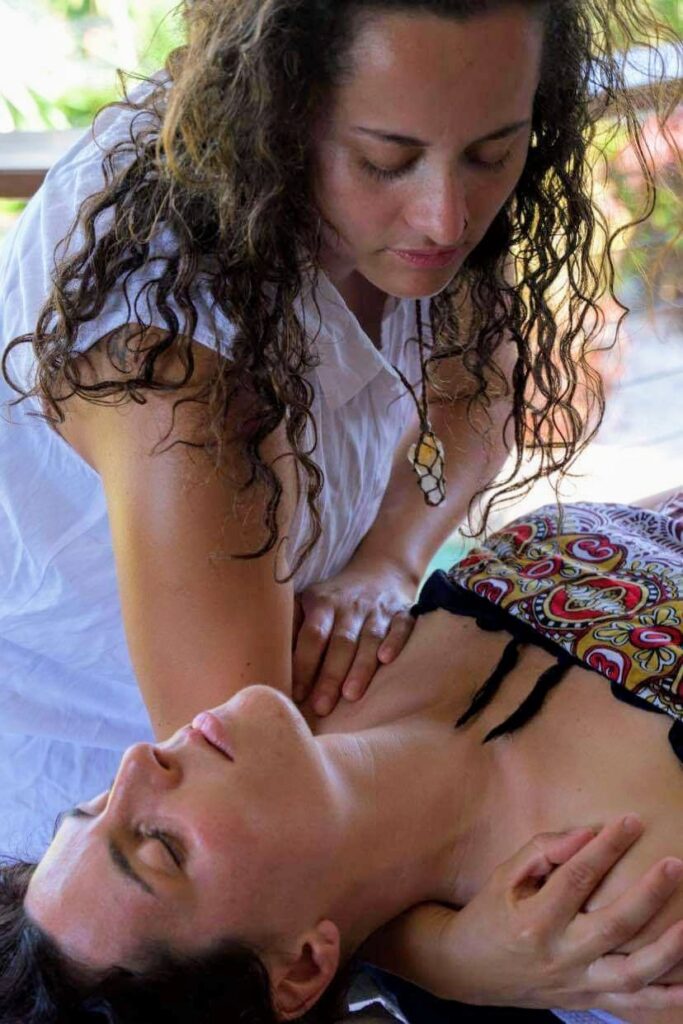
Book a Kahuna session with Lorena.
The signature flowing forearm-led whole-body bodywork, delivered through the Mette's Institute lineage. Sunshine Coast clinic at Valdora or mobile to your home.